In Transit

Tags

Never have I visited a place where boating is such an important form of travel. We took a high speed boat to Hydra and back, we took a huge ferry to Santorini and back, and those ten-hour-long day ferries can certainly be a challenge. So, these are my recommendations of what to do (i.e. things we did both on the way to Santorini and back) to keep from getting too bored on a ferry boat:

a. explore your floating hotel

b. stay hydrated

c. nap on the floor of one of the lounges

d. dry your socks (at least, until a porter tells you to move them)

e. rehash adventures

f. brainstorm short stories

g. eat a snack, preferably of ice cream

h. stain clothes with said ice cream, which, of course, is chocolate

i. chat with fellow passengers! Especially the ones with cool but nearly unintelligible Scottish accents

j. purchase a Borges story on the Kindle

k. translate and discuss said Borges story

l. if options j. and k. are unavailable, READ A BOOK for heaven’s sake! I hope you brought one.

m. ALWAYS, when possible, WATCH THE SUNSET

n. (N is for Necessary) keep good company. Time will fly. 🙂

Greece in all its Glory: Part III Episode 3: Excursion to the Caldera & Hot Springs

Tags

Our last day in Santorini required a trip to the caldera which had made the island what it was. We finally decided to pay for a boat excursion because in the end, the water taxi wasn’t operating due to the windy weather. The boat took us to Nea Kameni, and it felt like I was walking on an alien planet. The rocks that had spewed from the volcano were dark—the youngest ones the most dark—and there were many piles of rocks left by travelers.

Boris detected a hint of Slavic accent in our guide’s Greek, and started a conversation while we trekked up the volcano. He was from Serbia, finishing university, regularly came to the islands to work, wanted to study math in Russia or America. He had an easy smile and a fine sense of humor that showed through, even in his English. We got the history of the caldera, which I promptly forgot, and also he informed us about the numerous eruptions. The volcano is still active, and we placed our hands on certain vents in the rocks to feel the extreme heat it still emitted.

The second stop on our tour was the natural hot springs. A short jump off the boat and the water went from refreshingly cool to warm in a few yards. Other hot springs I had visited all were enclosed in some manner, so it was different and interesting to be swimming from the more open water to the more enclosed lagoon-ish area where the hot springs were. Once in a while the cool and warm water would mix, a strange sensation.

For our last evening in Santorini, we explored Fira Town, which until then we thought consisted only of the hospital and bus station, perhaps a few pharmacies. Naturally we were wrong, and I’m so glad we made it to the town itself. There were tons of shops lining the streets, which were thronging with tourists and locals doing their due passi (an Italian term, I know, but I don’t know it in Greek!) around in the pre-sunset hour. We got some gelato and figured we could find a good place to watch the sunset. Down a few unknown streets we found a spot near the highway, a bit out of the town. We could see the colors of the sky, but in the end found a much better place to watch the final moments of the day: along the top of Fira town, overlooking the whitewashed houses jutting off the side of the island, water below us, caldera in front. As the darkness approached, all the restaurants and homes lit up, and the view was almost as good—if not better—than in Oia. A perfect end to a wonderful last day in Santorini.

I didn’t have my camera with me, so this only vaguely resembles the beautiful spot and view we had of the sunset. It’s not really of Kamari, TripAdvisor lies. This is more what it looked like when the lights began to twinkle after dusk.

Kamari Photos
This photo of Kamari is courtesy of TripAdvisor

Greece in all its Glory: Part III Episode 2: Akrotiri & Oia

Tags

Santorini’s beaches are unique in that there is one at Akrotiri that is dubbed the “red beach” due to the red rock that it faces, and there is also the black sand beach we had visited earlier. Akrotiri is also the main archaeological site, but the site itself is closed due to an accident that killed a tourist a few years ago. We never made it to the museum, but we did hop on the bus to Akrotiri to check out the beach. The bus was crowded when we boarded; in fact, our clever boarding at the rear door enabled us to even get onto it! We scrunched in against strangers, and, in the natural course of travelers, became best friends for the next twenty-five minutes. An American from Montana was chatting with an Italian couple next to us (up against us might be more accurate) and eventually we all discussed the island, our homelands, I was able to utilize my Italian, and when we finally arrived at the bus stop we were ready for the beach.


Boris and I chose to walk to the beach instead of taking a water taxi for five euro, and it was five euro well saved. The walk wasn’t long, and by the time we got to the beach we were ready to dive into the chilly waters. Tourists crowded the beach, and its small size was noticeable. There was no shade, and a wind scattered dry leafy things across our towel, but the view was wonderful.


For lunch we found a fish taverna against the water. We saw our fish, which had been caught earlier in the day, and they grilled it for us whole. Boris’ biology background and years of dissection experience came in handy, and as we ate, he gave me a lesson in fish anatomy that I won’t soon forget. Not much was left of the fish when we were done—just the head!


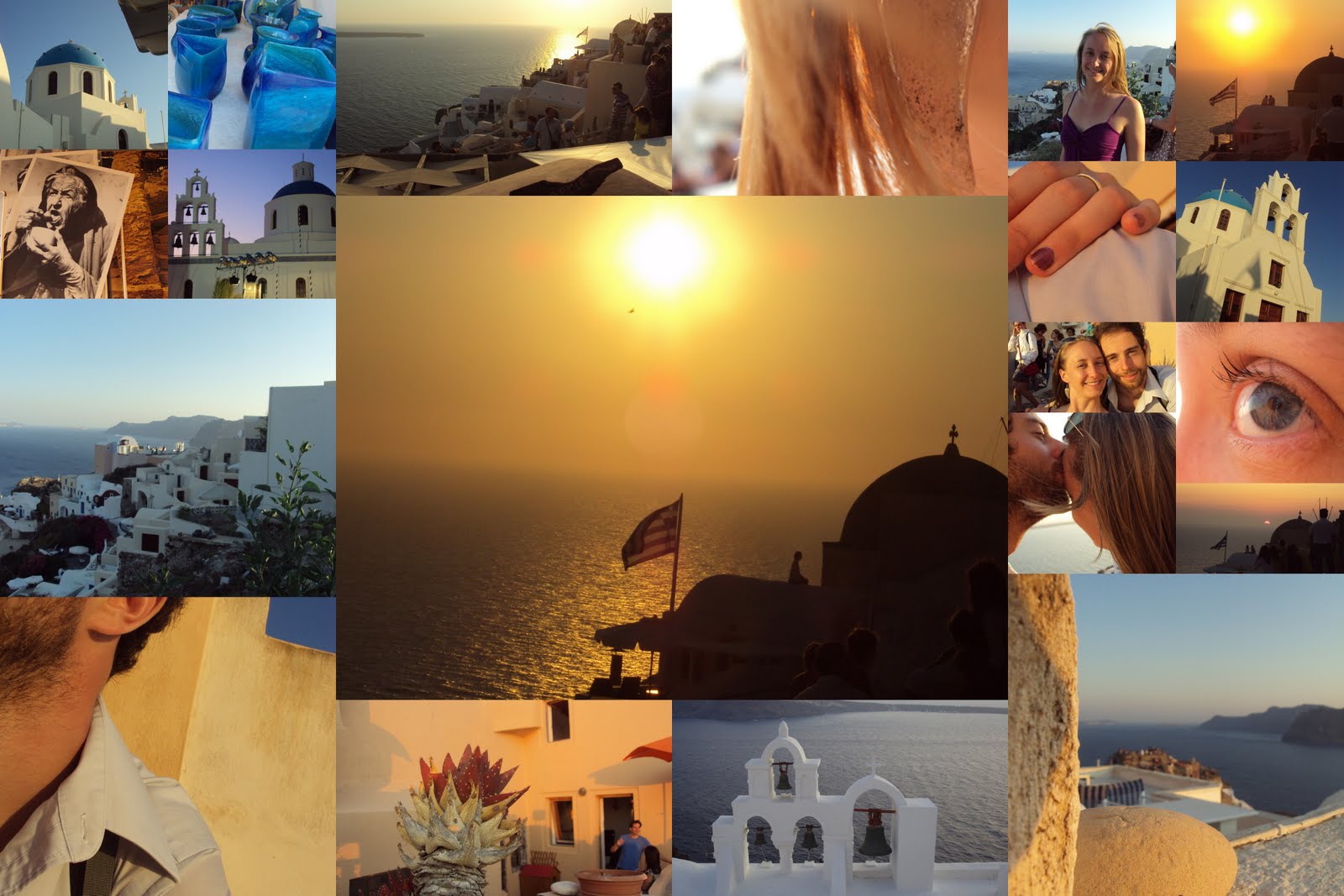
Later in the evening we got a bit gussied up and took another bus to Oia, where so many Santorini postcards are taken. When I think of a Greek island, I think of this: white buildings and rounded domes, blue speckling the cityscape on the sea, water shimmering in the background. That is exactly what we found at Oia, as well as hundreds of others trying to watch the sunset from the best vantage point. The light, a reddish yellow, warmed us as we found a roof of a creperie from which to watch the sunset. People, again scrunching together and making friends of strangers, found places on roofs, on steps, standing, sitting, families and lovers, all gathered to watch the end of the day. With us on the creperie roof were a British twenty-something and her mother, as well as a young couple of unknown origin. As the sun slowly sank beneath the horizon, we took dozens of photos, taking advantage of the perfect light.


When the sun finally set, the crowd applauded, which made me laugh. The masses dispersed, we ate another fantastic meal and made the second-to-last bus to our “home” in Karterados.

***Note: I have no idea why the font on this thing keeps changing. I’ve tried multiple times to keep it all the same font with no success! Forgive me!

Greece in all its Glory: Part III Episode 1—Arrival on Santorini

Tags

Santorini, one of the Cycladic islands, is fabled for its beautiful sunsets and picturesque landscape. Some purport it to be the legendary site of Atlantis (in fact, the textbook I taught from this past year uses this hypothesis). To be frank, ladies and gentlemen, it merits all its fame.


We arrived at the port around 6:45 a.m. The pension Boris had booked had a free pickup service from the port, so we rode to our next temporary home with George, one of the owner’s (a taciturn Greek who had married a sweet, soft-spoken British woman and they ran the pension together in Karterados, more or less in the middle of the island), and a couple from Uruguay. Luggage deposited, we were informed that check-in wasn’t until noon. Five hours to kill on a collective three hours of sleep in an unknown town led us first to a bakery up the street to procure some sustenance.


The young woman working at the bakery was friendly, and we got what would become our “regular” breakfast for our stay in Santorini: Spanikopita for Boris, a raisin & cream pastry for me, and we would share a cherry juice (YUM! I didn’t enjoy cherries until I got to Europe! I’m a big fan now) and a plain Greek yogurt. We munched lazily in front of the bakery and then slowly trod on to explore Fira, the nearby big town. We ran a couple errands and found a nice place to sit, with shade, at the hospital or urgent care center or something of the sort. We weren’t the only ones lounging there, either. A triad of coeds were napping on the other side of the planter we were sitting on, so I felt less strange passing the time chatting and beginning a game of Scrabble on my Kindle with Boris in front of the medical center.


Our next stop to while away the hours was a small souvlaki place where we were the only customers. The old man running the place seemed to epitomize a Greek islander: older but very tan, fit, with a kind smile. Again, we sat, we ate, we continued our Scrabble game, which I was losing. A territorial kitty sunned itself beneath a blue chair across from us, and prevented a sweet puppy from getting too close. The owner fed the dog some scraps and it lounged nearby, never getting too close for fear of the cat.


Noon finally rolled around and we made it back to Karterados. Our room was SWEET! The villa itself looked like the movies—just as with the rest of the Greek isles, the blue paint contrasted with the whitewashed buildings was the norm—and there was a beautiful lower courtyard surrounded by bougainvillea. Our room overlooked the courtyard, and we even had a kitchen! The location was great, too, because Karterados was not as full of tourists as Fira and Perissa, so the restaurants nearby were genuine Greek tavernas full of genuine Greeks.


That afternoon we took the bus to Kamari Beach, a black sand beach about ten minutes away by bus. I had never been at a black sand beach, and to describe the “sand” more accurately it was very pebbly and a little uncomfortable to walk on. The water was refreshing, though, and the waves were rolling. Our game of Kindle Scrabble ended at Kamari Beach with a triumphant Button and a defeated Boris. We watched the sunset from a beach side restaurant and noted that two different couples had dined behind us and left; we concluded that we were doing proper European-style eating and finished off the meal with a delicious digestivo of, I think, vinsanto.

Greece in all its Glory: Part II—The Port of Piraeus

Tags

The fast boat to Piraeus from Hydra dropped us off at the port in the afternoon, leaving us with about two hours to kill before we could board the ferry. For those of you who have been to Piraeus, you’ll understand when I say it’s not the most enticing place. For those of you who have not, just know that it’s a busy port city with little aesthetic redemption other than the water and the distant view of the hills in Athens. It’s also not the safest place, especially at night. We wandered around the port for quite some time figuring out where to pick up our ferry tickets, which we had purchased online long before.

Boris and his language skillz got us to where we needed to be, but in the process I learned well that Greeks aren’t the most specific people when giving directions. In Hydra I thought it was typical of the small town, since it seemed like many of the streets didn’t even have names. It turns out, it’s likely that it’s a Grecian trend, instead. We were instructed at one point by a workman for our ship itself to go to a certain ticket stand. We trek—Piraeus is a huge port—to the other side of the dock to a ticket booth. The guy there instructs us to go back to where we had just been, and that there “should be people there,” even though we had seen no one. It turned out that he meant to the other ticket booth near where we had been that had appeared closed and on the outside was labeled “Tickets for Vehicles” or similar. Tickets in hand we set off to find a place nearby to eat.

The immediate surroundings of Piraeus aren’t really built for tourists. There’s a big cafe/waiting area at the port, apparently a Starbucks nearby, or we could venture outside the port’s fences to find a local place. We chose the last option, and soon found ourselves at a cafe that served a few souvlaki-type dishes, a traditional dish made of tripe (we politely declined), and drinks. I don’t even remember what we ordered, but I know that by the end of the lunch, we got ourselves an invitation to come back whenever we were in Piraeus, and possibly some free watermelon.

Finally we boarded our ferry. Technically I had been on a ferry from the US to Canada, but it certainly was not a ten hour trip. The boat was ENORMOUS, and it felt like a floating hotel, because I guess that’s what it was. We had booked a private cabin since it was an overnight ferry and I wasn’t particularly keen on losing an entire night’s sleep when we had such little time in Santorini. Our cabin was neat—small, but totally functional and we even had our own bathroom. The shower in the bathroom just was a shower fixture attached to the wall, so essentially the bathroom WAS the shower, too. A pretty efficient design, when it all comes down to it.

We explored the boat and found a spot to watch our departure into the Mediterranean waters. Sunset on a boat is incomparable, even when the boat is spouting some nasty fumes once in awhile and there are loud teenagers messing around on the deck. The view was stunning. At some point the self-service restaurant opened and we got some overpriced but tasty food (Boris was obsessed with the orzo-lamb dish…I’ll try to replicate it when I get home…) and that was when the rocking of the boat and the stuffiness of the dining room got to me and we headed onto the deck for some sea breezes. The moon and its reflection over the water reminded me of old Impressionist paintings: the water and the moon’s reflection only a little bit blurred with the brush strokes.

Trying to sleep on the boat was difficult, despite our comfortable setup. We weren’t camped out in the lounge or sleeping in any corridors, so I can’t even imagine what it would be like trying to do that. The boat’s rocking wasn’t even the biggest issue, it was more than whenever there was an announcement I was concerned when we couldn’t understand its garbled message, and we didn’t know how many stops it would be until Santorini, so at one point maybe around 3 a.m. The boat stopped and we weren’t sure what was going on. We hadn’t thought to ask whether they’d be waking us up upon our scheduled arrival to Fira (they did, a porter knocked on our door to give us the 20 minute signal, by which time we had already been awake thanks to our set alarm clocks, Just In Case), so every stop woke me and caused a bit of anxiety. Finally, though, we did arrive in Santorini, which you’ll hear about next…

Greece in all its glory: part I–The Island of Hydra

Tags


On Saturday, July 9th I woke up at 4:30 a.m. and took a cab to Fiumicino Airport, only to get on a plane and fly to Athens. A week in Greece was mine with a certain fella, and I couldn’t wait. I landed rather bumpily in Athens and waited for Boris’ flight to arrive. It felt odd to be in a country where not only was I unfamiliar with the language, I was also less familiar with the alphabet. My year of ancient Greek could only prepare me so much to cope with its modern equivalent; first of all, it has been a couple years now that I’ve even read Greek regularly, so getting my head back into the Greek alphabet mode took some thought. Secondly, modern Greek is pronounced very differently from ancient, so even if I could read something I would certainly pronounce it incorrectly.


Luckily I didn’t have long to wait until I saw said fella’s face smiling at me from across the arrivals hall. Our first order of business was to get to Piraeus in order to take a boat to Hydra, our first stop on the trip. We lucked out with timing, and managed to get a bus with barely any wait time. The trip to Piraeus is a good half-hour, maybe forty minutes in Greek traffic (which is horrendous, by the way. I contend that the driving there is far worse than even Rome). The bus was crowded with other travelers like us, all coming from the airport with big luggage. We, luckily, only had an Osprey backpacking bag and my tiny Italian weekender-style rolling bag (note to self: not as convenient when wandering the city as a backpack, although excellent as a carry-on). A German family was trying to get off the bus, and the mother kept yelling to the driver by addressing him as “Driver.” He was unresponsive, and so a kind Greek man played translator for her and managed to let them off at the right stop.


At some point or other, Boris began talking to this Greek man, and it became the first instance of Greeks falling in love with him for his language skills. Scratch that: the ticket man from whom we bought our bus tickets was also impressed. This proved to be an enormous advantage while traveling, and also quite amusing for me. More often I am in the role of translator, so it was fun to be relieved of this duty, but also fun to see how surprised and excited Greeks got when Boris talked with them. Greek, unlike Italian or Spanish or French, is much less commonly studied, especially by tourists. By the end of the trip, I was used to hearing his brief Greek explanation about how he had been studying Greek for a couple years, and the Greek reaction of being really impressed and/or appreciative. Anyway, back to the Greek man on the bus, who became one of many temporary buddies during our travels. It turned out he was a gynecologist who had just come back from a conference in Rome. He and his wife told Boris, who later relayed it to me, about Hydra, where they had been before. He also was sure we got off at the right stop on the bus, and sent us on our way.


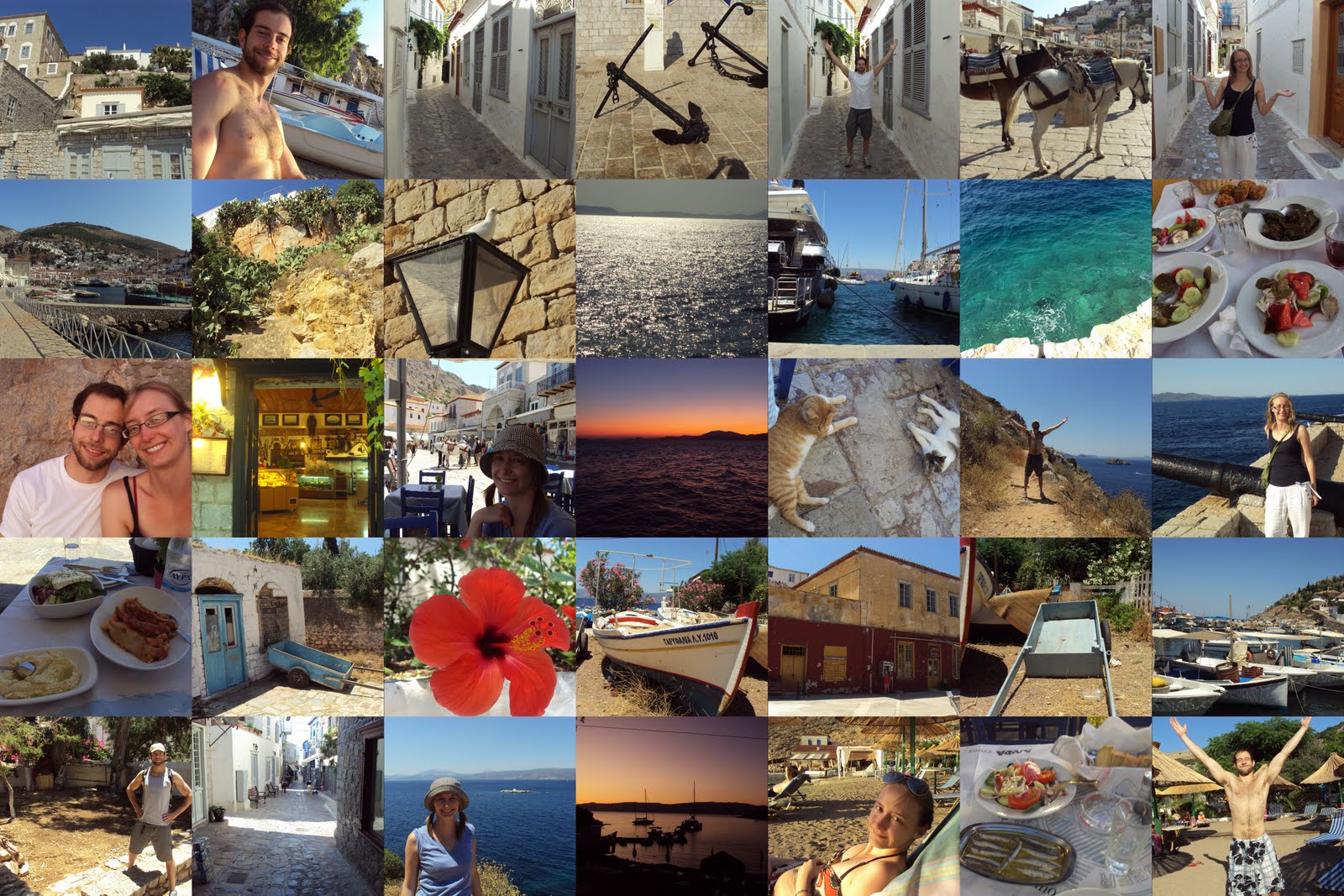
Our good timing continued and we waited less than an hour for the next fast boat to Hydra, which only took a couple hours. Hydra Town, the main town of the island, greeted us with the bustle of port-side, open-air restaurants and donkeys. A wonderful thing about the island, something that attracted us to it in the first place while reading in my Lonely Planet guide, was that there are no mechanized vehicles allowed on the island except those for maintenance. By foot or by quadruped was the only way to get around, and those donkeys hauled more than people: they hauled groceries, suitcases, you name it, they’d carry it. Although they weren’t terribly expensive to ride, we opted out of the offer to be taken to our pension and decided to wander and find it ourselves.

Even though Boris had printed a map, there wasn’t even an address on the website for this place. Getting directions was comical—“turn left and then right and then right,” or “go to the movie theatre and keep going and then make a left”–but we eventually made it. It took maybe fifteen minutes and two or three inquiries of the locals to make it to our place, where we were greeted by the owner. Like many island accommodations, our room was one of seven to ten in a villa-style home on the island, only 3 minutes from the port. Our room was situated on the lower level, so we didn’t enjoy any kind of courtyard view, but we didn’t plan on spending most of our time there anyway, so it was just fine.


Despite Boris’ 24-hour long flight schedule, he was a good sport and determined to overcome the onset of jet lag. We explored Hydra Town for a while, wandering up one side of the village to enjoy views of the waters below. We snacked on some crepes, and got a recommendation for a dinner taverna from the girl at the creperie. My first dinner in Greece consisted of dolmades (stuffed grape leaves), tzaziki sauce, zucchini balls and Greek salad (which became a staple of every single meal we ate except breakfasts). Italian food is wonderful, but the change was most welcome, as were the plethora of vegetables and salads offered at every single restaurant.


To finish our first day together in Greece, we walked back towards the port and claimed a spot on some rocks down a rickety stairwell that led to the sea. There we sat and admired the most beautiful sunset I’ve ever seen. I am loyal to Arizona sunsets, I’ll have you know, but this…this was magical. Perhaps it was the setting—perched on rocks that were being licked by surrounding salt waters, a sated belly, caring and warm company—but it was possibly the most beautiful thing I have ever seen.


For our first full day on Hydra we walked from Hydra Town along the other side of the island, exploring where we wanted, taking photos along the way, enjoying the island’s dearth of tourists. For lunch we stopped at a taverna on the port. Our gauge every time for pricing was to check how much the traditional Greek salad cost—if it was more than 5.50, we wouldn’t eat there. The one we found was delicious, and Boris again made a friend of the waiter. We asked him about beaches on the island, and he recommended a couple, all of which were nearby. The late afternoon took us along Hydra’s coast, again, to Mandraki Bay. There, we lounged on sunbeds and swam in the cool Mediterranean water, again almost alone. Perhaps only twenty people in total were around, including a Russian mother and daughter sitting right in front of us whom Boris managed to befriend as well. (Apparently a lot of Russians visit Greece.) From a taverna overlooking the bay, we watched the sun set and ate freshly caught and marinated little fish, salad, and pastizio.


The next morning marked our departure back to Piraeus to take the overnight ferry to Santorini; we were sorry to leave, since Hydra had treated us so well. For lunch we ate at the same port-side taverna as the day before, and our same waiter greeted us fondly. Only the evening before I had promised I would not eat in the same place twice, since we had so much at our fingertips; we had sat down at another restaurant only meters away from the first one and seen the hiked up prices. I caved immediately, especially since our lunch before had been so tasty, and we enjoyed our second meal there. The waiter also brought us two Mythos beers—a Greek beer that I actually really liked, which is unusual for me—and we had definitely not ordered them. Boris pointed out the benefits of being loyal customers, even though neither of us would have ordered that with our lunch, and we enjoyed them all the same. Due to our boat’s arrival and our quick paying, however, a different waiter brought us our check and we realized that it certainly had been gratis from our original waiter, since we ended up getting charged by the other guy. The thought was taken into account, however, and we decided if he had written our check, it would have been free. We sailed to Piraeus for the next part of our Grecian adventure…

Baths of Caracalla

Tags


I guess I’ll leave you with something to consider before my trip: my photo collage from the Baths of Caracalla, which Big Kitty and I spent quite some time trying to find…if only our spas were as intricately designed as these 3rd c. AD baths were…

Un Sabor de Mexico in Italia (My most parenthetical post)

Tags

Last night I cooked Mexican food—read: burritos—for Esa and a group of her friends (the number for which I was cooking remained a mystery until 9pm, so I did the best I could with what information I had). What I want to be clear about first is that the meal was generally very well received, and the kids were polite. That is my disclaimer. She and some of her girlfriends worked as sous chefs, cutting onions and dicing tomatoes, and I made “Mexican Beans” (kidney beans dubbed Mexican, with a landscape of cacti on the can) and cooked ground beef with only two cloves of chopped garlic. We had tortillas, which were made in Holland; to be fair, their overall quality was the same as the packaged kind in Safeways, I believe the brand is Mission or something similar…they’re flour, but not like the handmade ones we eat at home, that can also be easily found at a grocery store. Ah, I miss tortillas. We served it buffet-style, and twelve (rather than the 8 I had bought portions for) showed up. We ran out of meat promptly, and almost all the tortillas were gone by the end of the night (we had a stock of 24). They also liked the makeshift “nachos” I had made, which really was just melted provolone on tortilla chips. Oh, yeah: cheddar, American or Mexican cheese is un-findable in most places here. I made do with the provolone, and it was fine.

What struck me as most interesting was how funny they were about the food. Okay, so I understand the concept that certain cultures are more habituated to eating certain flavors. Fair enough. I would suppose that more Italians than Americans enjoy anchovies, and cook more with capers, certain bitter flavors we are less accustomed to. (Those are only two that come to mind, though there are tons more, of course. If anyone wants to share their observations, feel free.) What struck me as so odd was that onions and garlic were two ingredients that they seemed to avoid. In American-Italian cooking, garlic is abundant. Perhaps it is also that they use garlic more in the South of Italy? I have no idea, because the original bruschetta recipe is just toasted bread with garlic, olive oil and maybe salt and/or pepper.

Onions, in retrospect, I have seen less of in dishes on menus, although I am going to keep my eyes peeled to confirm this suspicion. In any case, some of the boys came in and one of the first things one kid said was, “che puzza!” (What a stink!) More than one commented on the odor of the cooking meat, and it must have been that—and the miniscule amount of garlic added—that so offended his sensibilities. Perhaps, too, the wafting scent of the chopped onion. I think I was the only one who added onions to my burrito. Granted, onions perhaps would have been better sauteed and put into the meat, but that was objected to adamantly by the co-hostess, whose tastes were not partial to onion. I promised her we could leave them on the side for them to choose whether they’d put them in their burritos. Personally, I adore the scent of onions cooking, and don’t mind at all when the kitchen smells that way for hours after. Apparently this is not a shared opinion in Italy?

When we finally gathered around to the table to serve ourselves, I introduced the dish and just said what we might normally put in a burrito, which was, essentially, everything on the table. I granted, of course, that they should eat how they wanted to, and they did. The beans were mostly left to the side, as were the onions. In a way, I guess I almost felt like the remaining food on the table was evidence of some sort of Italian hypocrisy—if I eat something “wrong” at an Italian table, trust me, I’ll hear about it. I can’t recall the number of times I’ve been chastised by friends for either mixing food on a plate (God forbid the balsamic vinegar from the salad touches the stray sauce of the pasta! Pasta must have its OWN clean dish!) or even eating things out of order (for example, eating another snack of olive oil & vinegar with bread AFTER the dessert/fruit course. OMIGODTHEWORLDISENDING! I can still hear Giovanni: “Ma, Sara, fa schiffo!” “But Sara, it’s gross!”). As much as they have my best interests at heart, I say this now and will forever believe that my dining experience is not lessened by those choices. I promise. Attribute it to my brutish Americanness, but I speak the truth. Part of me wanted to say, “But this is how it’s eaten! You have to eat it like this! Put some cheese on it, darnit!” because that seems like how things run in this country with their food. Not like burritos have specific rules or anything, and really you can put whatever you want in them, which is also part of their beauty. However, the food was enjoyed by all, and I was glad to be able to share it with them.

The reminder I got out of the experience was this: I am American. There are certain things that, no matter how many times I come here, will never change, just as there are certain things for Italians that would never change if they went to the States. Eating habits—other than my conversion to preferring aqua frizzante—I haven’t found to be very flexible for me. I’m happy to do things as much their way as I can while I’m here, so I can’t help but be a little sorry that a love of onions and garlic is not shared by people worldwide. One thing I am certainly looking forward to eating when I get home is a nice, real Mexican meal!