• About
  • Contact
  • Link Love
  • Miss Button’s Other Writings
  • Where I’ve Been

Bumblings Of Miss Button

~ Finding travel inspiration at home and abroad…

Bumblings Of Miss Button

Tag Archives: Italy

On traveling

03 Sunday Jul 2011

Posted by sarabutton in Uncategorized

≈ 1 Comment

Tags

Italy, Travel Musings

Being a traveler requires—rather, instills—a sense of capability and independence few other experiences can provide. The ebb and flow of a stable travel situation is the norm rather than the deviation. Quick decision-making skills come first: do we stay on the train or take a cab? Do I turn here or go straight? Do I touch the wares shoved in my face by aggressive vendors or no? (The answer is ALWAYS no here.)

Problem-solving skills are also part of the puzzle: learning to use all resources at one’s disposal is key. For example: recently, my dear friend Amy had to get from Athens to a remote town near Tripolis in the middle of the Peloponnese. She happened to be traveling on the first day of a two-day general strike. Her resources for transport were extremely limited, so she had to take a taxi all the way to the main town. Her colleagues still didn’t know her arrival time, and cell communication wasn’t working with them. Instead of freaking out, Amy texted me for another friend’s number who was also on the dig. She managed to get to her site safe and sound. Perhaps this sort of situation doesn’t sound so stressful from the outside; let me assure you, though, that when telecommunications are cut short, or (especially) public transportation isn’t running, and you’ve been traveling all morning/day/night in places where the language is foreign and all you want to do is put your stuff down and breathe, life seems a lot more scary. To overcome these kinds of obstacles successfully has certainly developed a sense of confidence and independence in me. Even an action as simple as getting from one place to another without getting lost, or getting lost but then finding the way again, I have found instructional.

Both of these skills, as well as the multitude of others, have proven to be invaluable in my life at home. The ability to think on my feet, the ability to read a map, the ability to trust my instincts are all useful! Most useful, however, is that I know I can do it. After my first trip abroad alone, I felt so much more confident in my choices. The art of letting things go, like specific travel plans, is not the most fun art to master, but the mentality that “I can deal with this,” is a nice one to have gained. I trust myself. I can never adequately express my gratitude to my parents for cultivating our sense of adventure and travel. For what it is worth, Mom & Dad: Grazie.

The Locks of Ponte Milviano

03 Sunday Jul 2011

Posted by sarabutton in Uncategorized

≈ Leave a comment

Tags

Italy

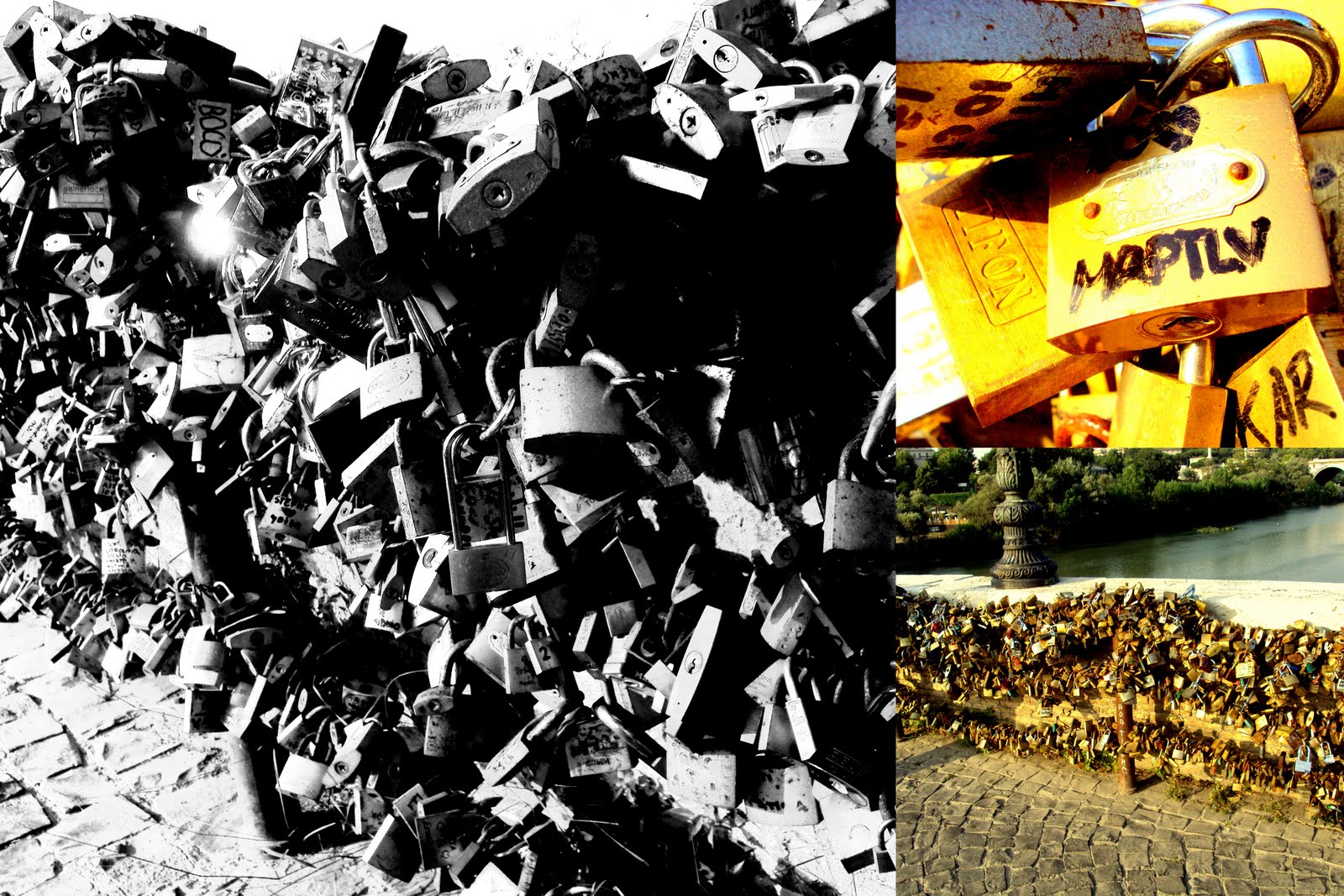
As a person who studied classical civilization for at least four years, my context for the Milvian Bridge is solely historical: in 312 CE, the Roman emperor Constantine defeated Maxentius after seeing a purported sign from God. This alone was my reference for a bridge in northwest Rome. In the past five years, however, the bridge has been given a new role. A story by Federico Moccia, in English entitled “I Want You,” featured a young couple who sealed their love by going to the bridge, locking a padlock to a lamppost, and throwing the key into the Tiber below. Such a romantic thing as this caught on quick, especially after the book—and its subsequent film—became popular. Not too long after, a couple lamps even broke due to the weight of the locks beleaguering them. Politicians made it an issue, and finally, the mayor and a few others managed to resolve the problem of amorous but destructive traffic: put some chains on the bridge supported by steel posts, where lovers can safely place their commitments.

Yesterday evening we went to see the locks. Probably thousands were locked together all over the steel posts, chains, some on lamp posts still. The graffiti so typical of Italy—love letters (I swear, Italians write the best graffiti)–is written all over the bridge now. Many Italian youths acknowledge that the originality of the action has passed, that it has become trite to go to the bridge and clasp a lock. Clearly it’s not so unhip, though, considering how many still grace the bridge. I share this because I went to see it, and wanted to know the tradition’s origins. These, sometimes more than the traditions themselves, fascinate me, and I was intrigued by the idea that Italy, a country so ancient, and so well known for its romanticism, could be enchanted by such a new tradition.

Ostia Antica and My Second Small World Experience

01 Friday Jul 2011

Posted by sarabutton in Uncategorized

≈ 1 Comment

Tags

Italy

A site I had never visited before in all my trips to Rome was Ostia Antica. Ostia Antica was the main port of Rome, and is similar to Pompeii in this main way: they are both huge archaeological motherloads of information and have been extensively excavated. The similarities, however, seem to end there. Ostia Antica gives us a view into the daily life of an average Roman, rather than the Romans who could afford a villa at Pompeii. The area is enormous; I have no idea how far I walked today, but it was a lot, so that’s useful for you.

Since it’s so close to Rome itself, Ostia is facilissimo to get to. I took the metro and then a train that basically drops you off across the street from the site entrance. I arrived around 9:45 a.m. And I was thrilled I had. Today was the first overcast day Rome has had in weeks, and the clouds were my companions on my little trip for most of the morning. Probably the most exciting thing about Ostia Antica in terms of its differences from Pompeii is this: WAY. LESS. POPULAR. Perhaps I happened to be there on an off day, being Thursday morning. If you look at my photo collage, you will notice that there are zero people in any of my photos, except myself. That was because there were not very many people there, period! Groups definitely arrived more frequently as the day (and the heat) wore on, but my advice to those of you who love travel but hate crowds is this: Check out Ostia Antica on a nice Roman morning! You won’t be disappointed.

I went with no agenda, and had no idea how expansive the site was, to be honest. I don’t know why I didn’t expect a city, but I enjoyed so much exploring all the back streets of the town. As I’ve said before, getting lost is one of the best ways to have an adventure, and almost as soon as I arrived and started walking down the Decumanus Maximus, I made myself scarce from the 5 other people who were already there. This, my friends, was not difficult. There were so many streets that end up leading farther than I imagined, some of which would end up at a villa or similar that had magical headless sculptures or detailed narrative mosaics. In a way, it reminded me, too, of some of the necropolises I had visited years ago. A site so enormous is difficult to maintain, and often I found myself knee-high in brush that hadn’t been cleared since fall or before. A few times I had to stop and turn around due to the overgrowth. If I had been vested in my dig pants and some good hiking boots, that overgrowth would have been an easy foe to defeat and trample. However, my trusty Birkenstocks were not entirely up to the task, and for that I was sorry.

For two-and-a-half hours I wandered back and forth, from the ancient port area to the forum, finally to the cafeteria, where I decided to eat. I had considered eating at a restaurant I had seen outside the site to finish my journey, but curiosity and hunger drew me to the cafeteria that was on-site. Having paid for my meal, I sat down and noticed a number of dusty Americans also eating. They must be excavating here, I assumed, and then heard a familiar voice. I turned around and there was my Latin 102 TA from the UofA! My second small world experience of this whirlwind trip, but this one was much less shocking to me. I knew she was in Rome, and it surprised me not at all that she would be digging at Ostia Antica. She invited me to see their site, which happens to be the oldest synagogue in Italy, I believe. It took me a long while to find the site (they had just finished eating and had to go, whereas I had just sat down to carbo-load), but I finally did after a number of wrong turns and finally asking at the dig lab. Tucked all the way back in Ostia Antica was their area, and it was nice to get a brief tour from her before making my way back to Rome.

By the way, you can enlarge the photos and photo collages that I post by clicking on them. I’m trying to do a better job this year of editing as many of my photos as I can to share! 🙂

The Angels Aloft

28 Tuesday Jun 2011

Posted by sarabutton in Uncategorized

≈ Leave a comment

Tags

Italy, Photo of My Day


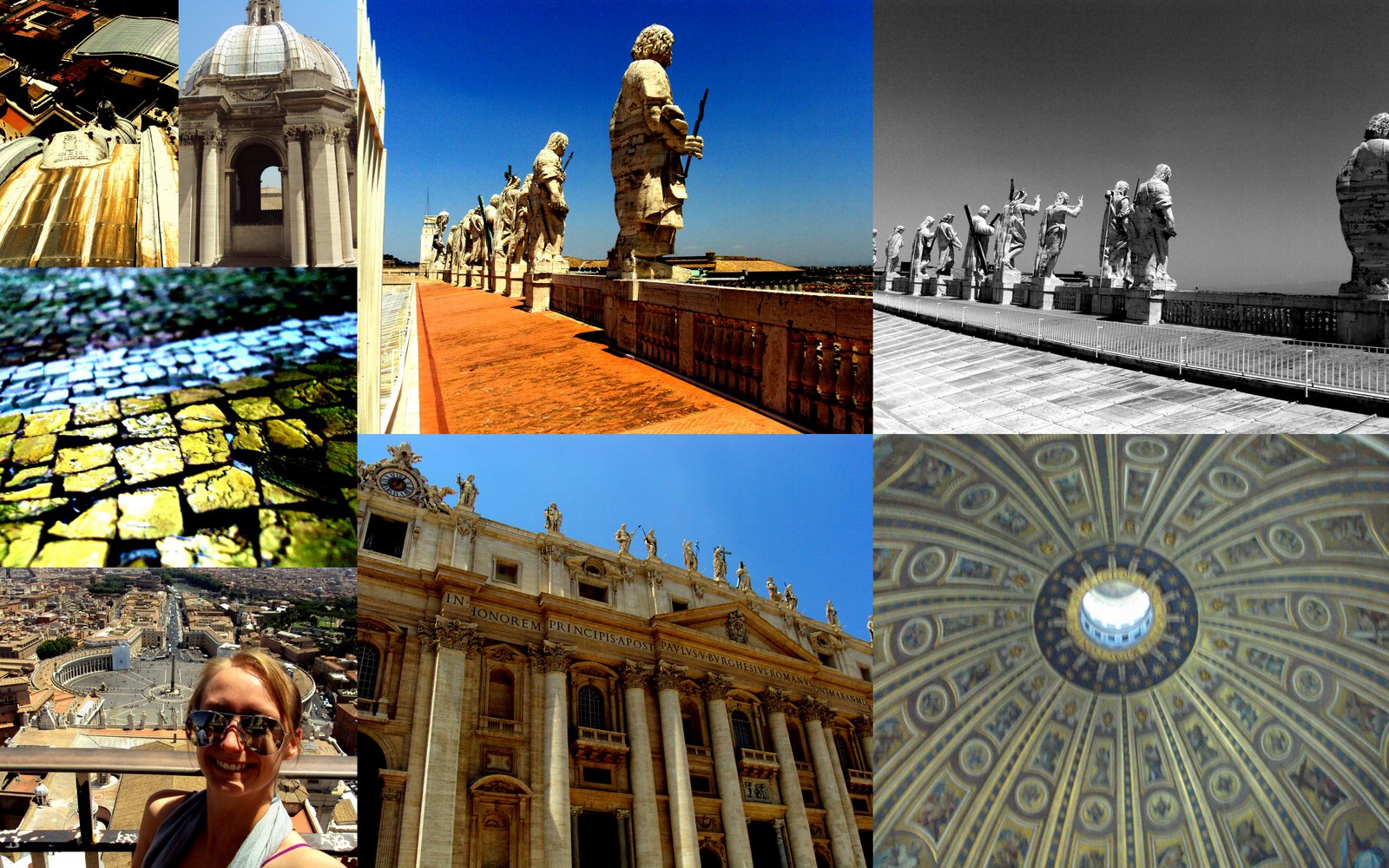
Collage of my visit to St. Peter’s

Posted by Picasa

Monday’s Exercise Program: Walking to and in and up St. Peter’s

28 Tuesday Jun 2011

Posted by sarabutton in Uncategorized

≈ 2 Comments

Tags

Italy

Mondays, when most of the monuments in Rome are closed, St. Peter’s Basilica is open to all to gape at its impressive decoration, enormous stature and soaring dome. So, I took myself to church. Having already been to St. Peter’s Basilica a few times, as well as the Vatican museums, I skipped the long line winding around the compound to see the Sistine Chapel and other amazing works the Vatican safeguards. I had made a promise: Monday was the day of the terza prova, and I said I would go say a prayer for our studentessa on her exam day. After all, I have much to be thankful for, as well, and to acknowledge it in the Chapel of the Blessed Sacrament wouldn’t hurt. I managed somehow to remain ignorant of the fact that my favorite sculptor, Gianlorenzo Bernini, decorated the chapel. I was too focused on my thoughts to look around much, and we weren’t allowed to take photos.

The most enjoyable part of the day was climbing the 1102 steps up and down of the cupola. The dome of St. Peter’s is the biggest in the world, and is definitely worth the trip! For only 5 euro you can get an excellent workout and some wonderful photos of Rome from above. I think my favorite part was being able to walk on one of the balconies to be on the same level as the angels that grace the top of the building. They reminded me of tall stone warriors prepared for battle, looking out over the city.


The Dark Side of Rome

26 Sunday Jun 2011

Posted by sarabutton in Uncategorized

≈ Leave a comment

Tags

Italy

Last night I was fortunate enough to be able to follow a tour guided by my friend, Laura. One of the companies she works for has recently started doing a tour that illuminates certain sites and stories that a regular tourist here wouldn’t learn, all of which have to do with the more macabre history of the city. The tour itself is an hour and a half long, more or less, so I don’t intent to share all of the things I learned on the tour (yes, yes, I took notes. I am cool.). I found every story interesting, and Laura is a born story-teller, so all of them were also engaging. Here are some highlights:

Le Madonnelle: All over Rome one may find depictions of the Madonna and child hanging up on the streets. 6,000, to be more precise. I hadn’t really noticed them before, but after Laura pointed them out, I saw them everywhere. They came about during the Renaissance, and there were three requirements for these Madonnelle. First, that it depicted the Madonna and Child. Va bene. Second, that there be a place for a torch (now, most of them have regular electric lights). Finally, and this is the most interesting part, is that they had to be anonymous. That means that people like Michelangelo were painting these Madonnelle, as well as others, but even know the city doesn’t know who has done which one. The fun fact about these public paintings is that they managed to lower crime a bit; Italians didn’t want to commit crimes in front of the eyes of the Virgin, but also it provided more light on the streets. Keep your eyes peeled for these when you make your next trip to Roma!

La Mascherone: on Via Giuglia, very near to the Ponte Sisto, there is a fountain with a facade of a big mask. Once upon a time, there was a political campaign in Rome; there were many candidates, but the one who stood out promised the city that if they elected him, he would make the fountain run with wine. Needless to say, he was elected. He did as he promised, and for twenty-four hours, the fountain ran with white wine! A few days before I went on the tour, I had passed said fountain, wondering what it was doing on a side street. Hearing the story of the wine fountain made it a much more exciting fountain.

The church of Santa Maria dell’Orazione e Morte: The church, named for Holy Mary of Prayer and Death, has some curious decorations on its facade—skulls grace the front of the church, rather than angels or similar. Many years ago, the group who ran this church was called the Fellowship of Death. They would go about and collect bodies of people who had died who weren’t buried properly, and give them a space in the church’s crypt. Very charitable of them, really. The church is located very near the Tiber, however, and when the Tiber flooded, the unsound construction of the crypt allowed the dead, literally, to rise. The solution? They collected the bones of those who had “escaped” the crypt and channeled their crafty sides to create decorations using the bones. Inside the crypt, one can see a chandelier made of backbone, as well as a giant cross made entirely of human skulls. The miracle of these bones, declared by the church (despite their declaration, too, that this type of construction is barbaric and henceforth outlawed) is that they have not deteriorated.

Giulia Tofana’s family business: In the 17th century, a Sicilian woman came to Rome in search of a business opportunity. She was quite an entrepreneur, and her business took off; in only a matter of years, she was able to retire young and go back to Sicily, leaving the family business to her daughter. What could be such a lugubrious venture, one might ask? Giulia had figured out an effective recipe for poison that rendered the liquid odorless, tasteless, and took 2 weeks to do its job. It came in a nice glass bottle with San Nicola di Bari on the front. The victim would show symptoms not unlike the flu. Giulia was furba, clever, and knew it would be best only to sell to women. About 600 men were killed by Tofana poison in the years when she was in Rome, as well as when the business continued for about a year with her daughter. It is here where the story begins to vary more. The story we heard was that the daughter took over the family business. Unfortunately for her daughter, the business was reported by a repentant wife, and 48 women ended up being hung for their involvement with the murders of men all over the city. Giulia herself was never caught, as she had already retired comfortably in Palermo. Other sources say that Giulia was caught, tortured, and, after confessing, was executed herself in Rome. Either way, we saw the outside of her home where she lived and did business. She was the most successful murderer Rome has ever had.

The death of Beatrice Cenci: The most disturbing story of the evening was certainly that of Beatrice Cenci, if only for the apparent injustice shown to her. There are multiple versions of this story, I was told, but in general, according to the oral tradition of Rome, her sad story goes like this. Beatrice Cenci was the most beautiful woman in Rome. So beautiful, in fact, that she was a model for artists like Caravaggio. Not only was she beautiful, she was also one of those beauties women can’t bring themselves to loathe because she was also a kind and generous woman, part of a very wealthy family in Rome. The citizens loved Beatrice. Her father, Francesco Cenci, happened to be terrible scum. He raped Beatrice, beat her often, and was in general an evil man. The Romans hated him, especially when he moved his family out of the city into Rome’s surroundings. One day, Beatrice snapped and stabbed her father to death. To hide the murder, she shoved him off a balcony of their home and insisted that it was an accident, he had gotten drunk and fallen. The Romans were happy to believe her, as that meant the awful patriarch was gone and Beatrice might be free to come back to Rome again.

There were a few kinks in this murder, however, the first of which being that her father had been dear friends with Pope Clement VIII, who happened to be a bit of a tool. Clement decided to persecute not only Beatrice, but her entire family, for the death of Francesco. The real reason, more than the loss of a friend, was because Rome had passed a law that said if a family has no apparent heir, the family’s fortune goes to the Pope. The Cencis were very wealthy, so this was how Clement played his cards. The Romans were outraged. Her mother and 2 brothers were tortured and confessed immediately, and were thrown in prison at Castel Sant’Angelo. Beatrice, however, stood firm and was sent to a prison meant for the lower class, meaning its conditions were even worse than a regular prison. Imagine a meter by meter space with two slits for light, and one hole for a bathroom. That was her residence for a while, until Clement takes her out. He has her hung by her hair, and she confesses. Penalty: beheading for all of them. Beatrice’s mother, elder brother, and even Beatrice herself were beheaded. People protested so irately that when Beatrice went up to the chopping block, they surged the area and four people were trampled to death.

The remaining family member was Beatrice’s fourteen-year-old brother. Clement, knowing full well the sentiments of the Romans, and also cognizant of the law that anyone under sixteen could not be publicly executed, pretends to grant clemency to this adolescent. The crowd finally disperses. The youngest Cenci does not escape a terrible fate, however. He is castrated at the Pope’s command, and dies soon in prison of a botched castration. Romans say that Beatrice is as generous in her death as she was in life. On the anniversary of her execution, she walks up and down the Ponte degli Angeli from dusk until dawn. She is only seen by men who have evil in their heart. So, if a lady ever hears her gentleman mention a beautiful but ghostly Italian woman he saw once on the bridge, she will know his true nature.

La Strage dei Lupi–The Wolf Massacre

25 Saturday Jun 2011

Posted by sarabutton in Uncategorized

≈ Leave a comment

Tags

Italy

“Break a leg,” is a commonly used expression in English to wish good luck to someone, although it sounds to a non-native speaker like a negative wish. In Italian, there is a curious expression to wish good luck that runs along the same lines: in bocca al lupo. This means, literally, “in the wolf’s mouth.” Whenever anyone has something to do that requires good luck wishing, especially exams, this expression is used. The proper response is not grazie but, rather, crepi (or,crepi il lupo), essentially meaning, “may the wolf die!” Years ago I heard the origin of this phrase from someone, but to speak truth, it seems that few Italians know its origin and that the story may differ anyway. Some things I’ve read have said that it originated in rural places where wolves were predatory; to kill a wolf was a difficult task, thus rendering someone who was successful in this venture quite accomplished. Another source or two mentioned the traditional story of Little Red Riding Hood, implying that when you go into the wolf’s mouth, may you be so lucky that the wolf will die and you will come out, safe and sound. Others have written that it is metaphorical and that the wolf is fear and you have to overcome the fear of whatever task it is that you are about to take up. Even further exists a possible connection with Rome’s foundation story, although it is unclear why any true Roma-phile would want the Capitoline Wolf to drop dead. If anyone can enlighten me on the true origins of this phrase, if there be any, please do. In any case, it’s part of an Italian-speakers vocabulary and I have been hearing it all over the place. I’ll tell you why.

The Italian school system differs tremendously from ours. At a typical American high school, a student might have to take 2-3 years of math, 2-3 years of a foreign language, 4 years of English, 3 years of science, 4 years of history, and can choose a variety of electives, which can range from art history to computer science to shop class. An American student usually does not specialize in subjects until university. To get into university, an American student should have a passing GPA and, in Arizona, I understand they have to have passed the state AIMS test.

In Italy, however, a student must choose their high school: liceo classico, linguistico, scientifico, artistico, all of them focusing more on the given subjects (classics, languages, science & math, art). To be able to enroll in university, students must pass the Esame di Stato conclusivo del corso di studio di istruzione secondaria superiore aka L’esame di Maturità. This exam consists of the following:

Three days of written exams (8:30 am until usually 3ish, although students may leave when they’ve finished):

La prima prova: Italian, which is the same for all students taking la maturità in the country. Students must write an essay about one of the topics given, which can range from the life of Enrico Fermi and his discoveries to the theme “We are what we eat” (both of which were on this year’s Italian exam). Different written sources are presented, not unlike an AP exam’s DBQ, and students must integrate these into their answers. There are a few options, always including a textual analysis of Italian literature or poetry, and students are encouraged to choose the option, of course, about which they know the most.

La seconda prova: This part of the written exam depends on what type of liceo you attend. If you go to a classical school, it would usually be a passage of Latin or Ancient Greek. For the liceo scientifico this year, they had (an apparently brutal) math problem that is accompanied by relevant sub-questions.

La terza prova: Possibly the most difficult part of the exam, this is where the student must be prepared for all subjects, but will write on four topics chosen by the examining commission, I think.

L’orale: An oral exam, the committee of which is comprised of three of the student’s teachers, three external teachers and an external president. During this exam, the examining commission may ask the student questions from any of their subjects; the goal, however, is not to ask about all topics but to insure that the student knows more or less what they’re talking about and can successfully defend their opinions and analyses.

The entire score is made up of not only the student’s grades from their last year at school, but also the scores of all portions of this exam; additionally, a student may earn 5 bonus points, depending on their scores on other parts of the test. From 2009 until now, a passing score was 60 and the highest is 100.

Currently, Italy’s youth is in a time of panic. The exams began last week, and will continue until around the middle of July, when the oral appointments are over. Everyone who was taking the exam did Italian last Wednesday, and that was all anyone could talk about. It was on the news on TV, discussing which topic was most chosen out of the options, it was in the newspaper, interviewing students coming out of their tests, students are studying like maniacs, writing practice essays and figuring out where they can rewrite them so as to be accessible during the tests. Parents rehash their own memories from doing la maturità. Once the exams started, students would come home and be on the phone all afternoon with their friends talking about what they did and how.

Due to this national sense of anxiety, which has spread from the students to their parents and relatives, phones have been ringing off the hook all to say, “In bocca al lupo!” Which brings me to my point: thousands, maybe millions of wolves have died in the past couple weeks. Every single person who has called to talk to Esa about her exams has said the phrase. Every time the phone rings, instead of an angel getting its wings, it’s another poor wolf dying violently all lone in the woods somewhere, perhaps in Eastern Europe. PETA would never stand for it.

I leave you with this thought, American readers: be grateful. Be grateful that we don’t have to do these exhausting, extensive and often impossible exams to get into college. I won’t argue that it may be a better gauge of college readiness (although, from what I understand, the rampant cheating on these types of exams may be a better indicator of how clever the student is rather than how much they really know). A comprehensive exam required to pass to the next level is certainly something I could support, and do, in fact, at my own job. The amount of information required, however, for this exam and its rigor is truly impressive, and I can only beg you now, dear reader, to be grateful. For the sake of the wolves.

10 Things Italy Reminds Me

25 Saturday Jun 2011

Posted by sarabutton in Uncategorized

≈ 2 Comments

Tags

Italy, Travel Musings

I always forget these things until my old friend Italia reminds me of them. Simple, but important.

  1. The light, in the afternoon, especially, is different everywhere. Here, it is warm and reddish.

    9. Eating fresh fruit and veggies is SO GOOD.

    8. In fact, eating slowly and enjoying one’s food and company is also SO GOOD.

    7. clotheslines, where practical, are the best ways to dry clothes.

    6. Linen is one of the most comfortable textiles.

    5. No matter your religion or creed, the sight of a beautiful church facade tucked away in some forgotten pocket of the city is a treat.

    4. Language should be musical.

    3. Gesturing more while speaking must burn more calories…

    2. It pays to know your vendors, food or otherwise. Seriously, loyalty=friendship AND discounts!

    1. Twisting streets where one can easily lose oneself is the surest way to an adventure.

Arte Antica and St. Agatha

22 Wednesday Jun 2011

Posted by sarabutton in Uncategorized

≈ Leave a comment

Tags

Italy

When I stay at the apartment and work, I somehow feel like some sort of bum who isn’t taking advantage of her surroundings. I have to overcome this feeling, since part of the advantage of having a place to stay is to get things done, seeing as I return to the States and immediately a) go back to work and b) move to a new house. Productivity is good. However, I decided to go on Tuesday on an adventure. I needed to get my bearings, so I took a bus to Piazza San Silvestro, walked to the Trastevere area and accidentally ate lunch at a cafe instead of a restaurant. I think I wasn’t paying attention, and perhaps they had a board with pastas on it, but in any case, I ate a really tasty tuna salad (lettuce, cabbage, onion, capers, tuna, potatoes, salt & oil). It was better that way, in the end. I felt like I was keeping a more balanced diet, which was something I struggled with last time I was in Italy.

I had forgotten that John Cabot University has a campus in Trastevere, so it was funny to see so many Americans outside the city center, not lugging big cameras and carrying around maps.

After lunch, I stumbled upon an art gallery: The Galleria Nazionale d’Arte Antica di Palazzo Corsini. I had intended to end up that day at a different gallery of ancient art, but this one was interesting, too. It had some Rubens paintings, as well as a nice Caravaggio. There were more people working there than visiting; I think I was one of three patrons who were perusing the one floor of art they had.

One of the rooms was solely dedicated to Giovanni Lanfranco, a follower of Caravaggio who had done two of the same painting; one is usually in Parma, the other in Rome.* The displays detailed the restoration of the works, as well as analyzed the differences between what at first glance seem identical. Although I am familiar with the iconography of many important saints—St. Bartholomew was flayed, St. Sebastian has the arrows, etc.–I hadn’t heard of St. Agatha and her torture.

According to sources, Agatha was a young woman of a noble family in Sicily who dedicated her life to God. She was courted by Quintianus, a Roman prefect. He did not accept her refusal of him, and had her persecuted. Apparently she was sent first to work in a brothel as punishment, but stayed steadfast in her faith. After a while he sent her to prison instead; she continued to refuse him and to stay true to her beliefs; one of her tortures was to have her breasts cut off. In many of her depictions, she is carrying a plate with her breasts on it. A miracle transpired that she had a vision of St. Peter, who came to her and healed her. As to her actual death, I’ve read a number of different things: she died during torture, she died from being burned at the stake, and that she died in prison. I guess all of these could be possible, but in any case, she has been part of the canon of martyrs for a very long time. The grotesque violence she endured struck me. Mutilation, I suppose, is run of the mill for martyrs, but a woman being depicted with the focus on her breasts in Christian art was intriguing. Some of the art has an undercurrent of dark sexuality that is startling for that period.


St. Agatha, today, is the patron saint of the following: bakers, bellfounders, breast cancer, fire, earthquakes, eruptions of Mt. Etna, jewelers, martyrs, natural disasters, nurses, rape victims, single laywomen, sterility, torture victims, volcanic eruptions and wet nurses (thank you, Wikipedia).

Just some food for thought. After I perused the gallery, I went to Castel Sant’Angelo and roamed the papal fortress/mausoleum of Hadrian. Calculating using Google Maps I only walked about 5 miles, but it definitely felt like more in under the hot sun.

*I couldn’t seem to find the version that has been housed in the Corsini Palazzo all these years; you’ll just have to come to Rome to see the differences.For some more interesting depictions of St. Agatha, her healing and torture, see here, here, and here.

An interesting modern depiction can be found here.

A Roma Fa Caldo

20 Monday Jun 2011

Posted by sarabutton in Uncategorized

≈ Leave a comment

Tags

Italy

It’s different to be in a place not as a tourist but as a visitor. In my number of times to Italy, I have seen most of the things in Rome I want to see as a tourist: the Colosseum, the Forum, Trajan’s Forum & Markets, Trajan’s Column, the Vatican and its museums, Capitoline Hill and its museums, St. Peter’s, the Borghese Gallery, all the famous piazze with their famous centerpieces, the Pantheon. I’ve walked Via del Corso many times, taken photos at the Spanish Steps and admired the Etruscan collection in the Villa Giulia. I am very cognizant of my good fortune to say I have done these things; I thank my parents immensely for bringing us here in the first place, years ago, and for supporting our travels, near and far.

As such, the sights I have left to see, of course, are many, but they are the less “important,” in the sense of the Grant Tour of Rome: I still have to explore the Trastevere neighborhood, go to the Catacombs, see Ostia Antica, spend more time, perhaps, in the Borghese park. There are always more churches. I take fewer photos now of monuments, and more of people.

This being the case, my days here will be more filled with the quotidian practices one succumbs to when a place becomes more of a stopping point than a touring point. Today, for instance, I woke up around 8, got out of the house with Umberto around 9:30, got some things at the pharmacy that I needed, we went to his school (they post grades here), I went off on my own to have a little walk around the Spanish Steps. Their school is situated next to Piazza Spagna, so I made my way down to Via del Corso, walked to Piazza del Popolo, and turned around. I didn’t know what I was looking for, if anything. It’s getting hotter here, and in the morning the advantage of being out that early is simply that there are fewer crowds. I knew I wanted to sit for a little while and maybe have a cornetto and even—gasp–a cappuccino, which I never drink, but figured it would be poetic and appropriate, or somesuch. The problem was that the entire area seemed full of overpriced cafes for tourists. I knew the Italians had to go somewhere, and in all likelihood it was not down Via del Croce, where I ended up. But I was getting warm and wanted to sit down.

The cafe itself was very near the Spanish Steps. Across from it were two or three other cafes, all dueling for business among the tourists. I sat and ordered my snack, and listened as the waiters tried to lure in the others. Yelping at passers-by, the waiters’ continual shouts of “cafe, Italian beer, pizza, spaghetti, pasta, panini,” must get old for the residents above them. Sometimes they would say hello in the language they assumed the people spoke; I heard some unintelligible konichiwas and many holas. Sometimes they were right, but often they were wrong. Across the way, I overheard a conversation between one of the young waiters who seemed to like very much the guessing of provenance. “Mexican?” he asked his clients, who were clearly not (at least, to me). The woman looked at him over her bedazzled shades and said, “American.” Tourists, 1, Cameriere, 0.

← Older posts
Newer posts →

Categories

Recent Bumblings

  • Liebster Awards!
  • 2013: In Retrospect
  • On My First Fall in Pittsburgh
  • Photo of my Day: Pittsburgh Zoo
  • Miss Button’s Packing List: Costa Rica

Popular Posts

  • Liebster Awards!
  • 2013: In Retrospect
  • On My First Fall in Pittsburgh
  • Photo of my Day: Pittsburgh Zoo
  • Miss Button's Packing List: Costa Rica

Enter your email address to follow the Bumblings and receive notifications of new posts by email.

Bumblings on Facebook

Bumblings on Facebook

Bumbling Tweets

Tweets by SaraMelanie14

Tags

accommodation animals Announcements Arizona Austria beach books Broadway Brooklyn California carnival clothing Costa Rica Croatia Czech Republic dance desert Dresden female travelers food Fourth of July France gear Germany Greece holidays home hostels Independence Day Ireland Istanbul Italy July 4th Kurentovanje London museums music Netherlands New Orleans NYC Oregon organic Orvieto packing Pennsylvania photo Photo of My Day photos Pittsburgh Prague Ptuj quotes Recipe restaurants Rome Salzburg Scotland shopping sloths Slovenia snow Sonoma County souvenirs Spain summer Things to do travel Travel Musings Tucson Turkey Uncategorized United Kingdom USA videos Zagreb

Meta

  • Create account
  • Log in
  • Entries feed
  • Comments feed
  • WordPress.com

Archives

Create a free website or blog at WordPress.com.

Privacy & Cookies: This site uses cookies. By continuing to use this website, you agree to their use.
To find out more, including how to control cookies, see here: Cookie Policy
  • Subscribe Subscribed
    • Bumblings Of Miss Button
    • Join 36 other subscribers
    • Already have a WordPress.com account? Log in now.
    • Bumblings Of Miss Button
    • Subscribe Subscribed
    • Sign up
    • Log in
    • Report this content
    • View site in Reader
    • Manage subscriptions
    • Collapse this bar